
Ceiling wallpaper installation works best in smaller, defined rooms such as powder rooms, dining rooms, nurseries and bedrooms, using a lightweight non-woven paper hung on a smooth, primed ceiling. It is harder than papering walls because you work overhead, fight gravity on every strip, and must plan where the pattern starts so it lines up with the room's focal point. WallpaperCraft Pro, a wallpaper installer based in Bellevue, WA, hangs ceiling papers in homes across Seattle and the Eastside, and most homeowners get the cleanest, safest result with an experienced pro.
Key takeaways
- The "fifth wall" suits rooms where people look up or linger: powder rooms, dining rooms, nurseries and bedrooms.
- Lightweight non-woven papers are usually best overhead because they stay stable as they dry.
- Plan pattern direction and the starting line first; a centered light fixture or the main doorway view usually decides it.
- The ceiling must be smooth, sound and primed. Have older textured or "popcorn" ceilings professionally tested before disturbing them.
- Safe staging and a second set of hands make the job faster and the seams cleaner.
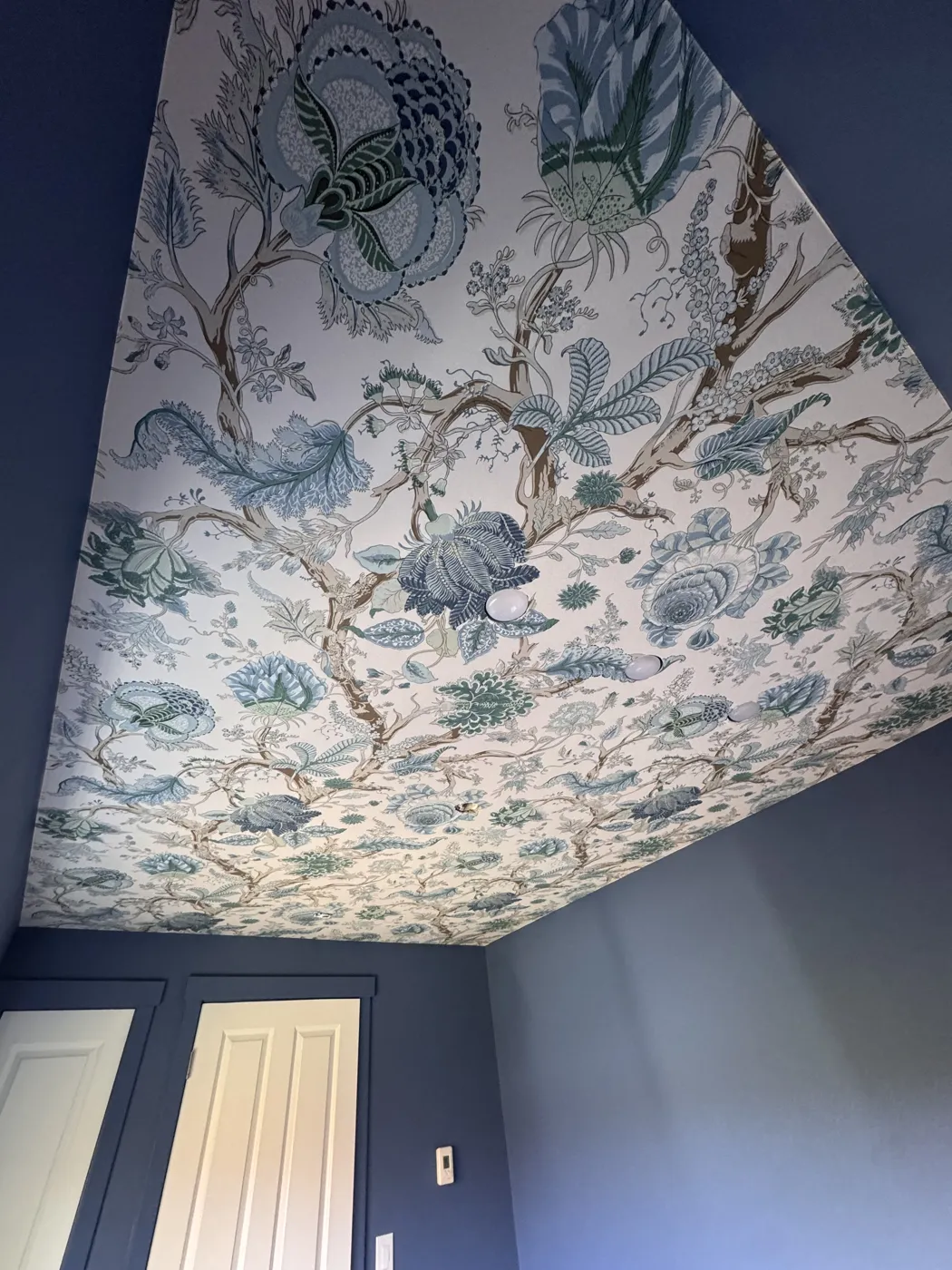
Why put wallpaper on the ceiling?
A papered ceiling adds color and pattern without competing with art, furniture or windows. Designers call it the fifth wall because it is often the largest uninterrupted surface in a room and is usually left plain white. It can make a tall room feel cozier or give a small room a jewel-box quality.
Which rooms suit ceiling wallpaper?
Ceiling wallpaper suits rooms where people linger or naturally look up, especially smaller rooms with a clear focal point.
Powder rooms
Limited wall space makes powder rooms the most popular place for a papered ceiling. If the room has a shower or weak ventilation, choose a material rated for humidity; our guide to wallpaper for bathrooms and powder rooms explains which papers tolerate moisture.
Dining rooms
A centered chandelier gives the pattern an obvious anchor, and papering only the ceiling or a tray recess keeps walls simple for art.
Nurseries and bedrooms
Soft clouds, stars and small-scale prints are common nursery choices. In bedrooms, a papered ceiling over the bed creates a canopy effect; quieter textures and tone-on-tone patterns tend to age well. For paper choices, timing and ventilation in a baby's room, see our nursery wallpaper installation guide.
What wallpaper works best on a ceiling?
A lightweight non-woven paper is usually the best wallpaper for a ceiling. Overhead, weight and stability matter more than on walls, because every strip starts pulling away the moment you let go.
- Non-woven papers are the usual first choice. They are light, resist stretching and shrinking as they dry, and many are paste-the-wall, so you are not lifting a heavy, wet strip overhead.
- Traditional paper-backed papers can work but need booking (relaxing the pasted strip) per the manufacturer's instructions and are heavier when wet.
- Heavy vinyls and grasscloth are possible but much more demanding. Grasscloth's natural color variation between panels is very visible on a large, evenly lit ceiling; our grasscloth and designer paper guide covers how pros handle it.
- Peel-and-stick can sag or release overhead, especially in damp rooms. Confirm the manufacturer approves ceiling use.
Always use the adhesive and primer the paper's manufacturer recommends.
How do you plan pattern direction on a ceiling?
Plan from a snapped reference line centered on the light fixture or room, and decide which wall the pattern should read from before you cut. Ceiling edges rarely run square, so layout separates a professional result from an awkward one.
- Strip direction: Strips often run across the shorter dimension so each is easier to handle.
- Where the pattern starts: Center the pattern on the light fixture or the room's center point and work outward, so partial motifs land evenly at opposite edges.
- Orientation: Directional designs (birds, trees, stemmed florals) need a "top." Decide which wall the pattern reads from, usually the entry or the head of the bed.
Straight, half-drop and random matches behave differently overhead. Our pattern matching explainer covers how each affects layout and waste.
How do you handle light fixtures, vents and crown molding?
Cut the power, remove every cover you can, and trim the paper so the cut edges hide behind canopies, trim rings and molding.
Light fixtures: Turn off the circuit at the breaker and drop the fixture canopy so the paper tucks behind it. Hang the strip over the box, make small relief cuts from the center outward, and trim within the canopy's footprint. Call a licensed electrician for anything beyond loosening the canopy.
Recessed lights, vents and detectors: Remove trim rings, grilles and detector bases, paper over, trim to the opening, and reinstall. Confirm smoke and CO detectors work afterward.
Crown molding: Crown gives a clean stopping line, but the junction is rarely perfectly straight. Trim with a broad knife and a fresh blade, changing blades often. Without crown, a deliberate trim line or fine caulk bead keeps the corner crisp.
Why is ceiling wallpaper harder than walls?
Ceilings are harder because you work against gravity, in a tiring position, under light that exposes every flaw.
- Gravity: A pasted strip wants to peel back, especially in the first few feet.
- Light: Windows and fixtures light ceilings at low angles, highlighting every seam and flaw.
- Out-of-square rooms: Without a true reference line, the pattern drifts.
That is also why ceilings are usually quoted differently from walls: access, ceiling height and the number of fixtures all affect labor. Our overview of what affects wallpaper installation cost explains the rest, and a written estimate is the best way to know what your room involves.
How should you prep a ceiling for wallpaper?
A ceiling must be smooth, sound, clean and primed before any paper goes up. Fill cracks and nail pops, sand repairs flush, and apply a wallcovering primer suited to the paper. Older Seattle homes often have plaster ceilings whose hairline cracks and loose areas need repair first. Newer drywall ceilings in Bellevue, Redmond and Sammamish may still need a skim coat if they have orange-peel texture or visible tape joints.
Popcorn and textured ceilings: Wallpaper will not lie flat over heavy texture, so it is usually removed or skim-coated smooth. Some older textured ceilings contain materials that can be hazardous when disturbed, including asbestos in some cases. Do not scrape, sand or wet-strip an older textured ceiling until a sample has been tested by a qualified professional or accredited lab, and follow local rules for any abatement. Our guide to wall preparation for wallpaper covers repairs, skim coats and primer in more detail.
In damp Pacific Northwest months, give primer and skim coats full drying time.
How do you set up safe staging for ceiling work?
Work from a stable platform that runs the length of the strip, not from a single stepladder. A lone ladder means constant climbing and sideways reaching, which is risky and bad for seams. Use a plank between two sturdy ladders or trestles, or a rolling scaffold with locking wheels in larger rooms. Cover furniture, keep pets and kids out, and cut power to any fixture you work around. If you would rather hand the job off, our checklist on how to choose a wallpaper installer shows what to ask.
Ceiling wallpaper installation step by step
The sequence is prep, layout, staging, then hanging from the center line outward.
- Measure and order: Account for pattern repeat and trim waste; order rolls from one batch.
- Prep and stage: Repair, skim coat if needed, sand, prime, and set up a platform along the first strip.
- Remove covers: Shut off power, drop canopies, remove grilles and detector bases.
- Snap a reference line: Measure from the center point or fixture and snap a true line for the first strip.
- Cut and paste: Cut strips with extra length; paste the ceiling or paper per the manufacturer's method.
- Hang the first strip: Accordion-fold it, align to the line, and smooth from the center outward while a helper supports the folds.
- Match and continue: Butt seams tightly to the pattern match and roll lightly.
- Trim at walls or crown and around openings with a fresh blade.
- Clean and reinstall: Wipe off paste, let it dry, then reinstall fixtures and detectors.
Frequently asked questions
Can you put wallpaper on a ceiling?
Yes. Wallpaper on the ceiling is a well-established design choice, often called the fifth wall. It works best on a smooth, primed ceiling using a lightweight non-woven paper and the adhesive the manufacturer recommends. The job is more demanding than walls because of overhead work, so careful layout, safe staging and a second person are strongly recommended.
What type of wallpaper is best for a ceiling?
Lightweight non-woven wallpaper is usually the best choice for a ceiling. It stays stable as it dries, is easier to handle overhead, and many styles can be hung by pasting the surface instead of the paper. Heavy vinyls, grasscloth and peel-and-stick products are possible in some cases, but check that the manufacturer approves them for ceiling use.
Can you wallpaper over a popcorn ceiling?
Generally no. Wallpaper will not bond evenly or look smooth over heavy texture, so the ceiling is usually removed or skim-coated flat first. Before disturbing any older textured ceiling, have a sample professionally tested, because some older textures contain hazardous materials such as asbestos. Follow local requirements if abatement is needed.
Where should the pattern start on a ceiling?
In most rooms, start the pattern centered on the main light fixture or the room's center point and work outward, so partial motifs are balanced at opposite edges. For directional designs, also decide which wall the pattern should "read" from, usually the main entry. Always hang from a snapped reference line rather than following the wall edge.
Which rooms look best with ceiling wallpaper?
Powder rooms, dining rooms, nurseries and bedrooms are the most common choices. These rooms are often smaller or have a natural focal point, such as a chandelier or bed, and people spend time looking up in them. Ceilings in entries, tray recesses and reading nooks can also be good candidates for a papered fifth wall.
Should I hire a professional for ceiling wallpaper installation?
For most homeowners, yes. Ceilings require overhead handling, precise layout from a reference line, work around electrical fixtures and safe staging. Mistakes are very visible because light falls across the ceiling. An experienced installer can also assess whether the surface needs repair, skim coating or testing before any paper goes up.
Ready to paper your fifth wall?
WallpaperCraft Pro is based in Bellevue, WA and installs ceiling wallpaper in homes across Seattle, Bellevue, Kirkland, Redmond, Sammamish, Tacoma and 16 more Puget Sound cities. Call (213) 645-9101 or visit wallpapercraftpro.com to request a free estimate; we reply to quote requests within 24 hours.